Ah, vale, creo que ya entiendo el problema.
Resulta que en realidad no entiendes lo que estamos diciendo.
Te ves obligado a usar Claude, que comete errores, y eso genera malentendidos. Déjame reformularlo para que quede más claro:
Mi comentario no tiene que ver con la contraseña (código PIN) que cifra y protege el monedero del usuario.
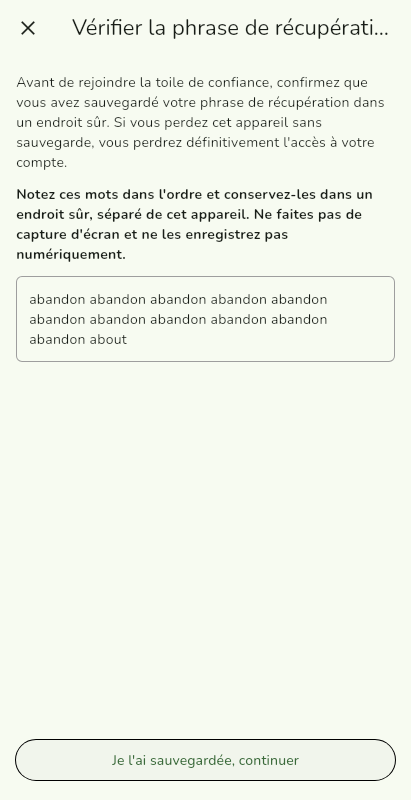
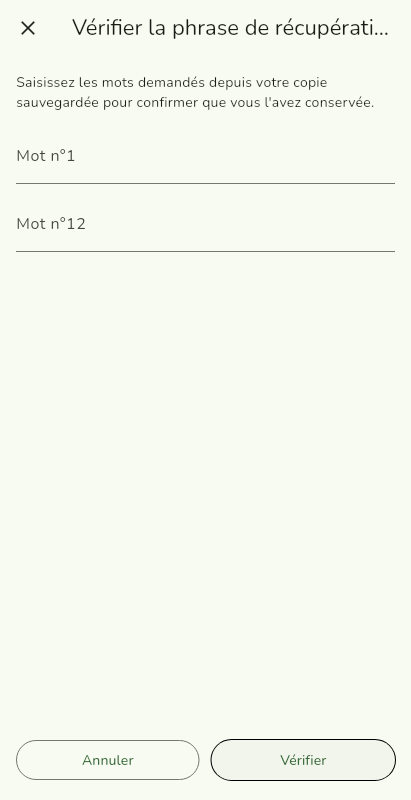
Mi comentario trata sobre el mnemónico. En Gecko, la aplicación se asegura de que el usuario haya anotado correctamente su mnemónico, no solo antes de crear su bóveda, sino también durante la confirmación de identidad (precisamente por eso sería contraproducente hacerle preguntas de opción múltiple en ese momento, además de este paso esencial).
De esta manera, nos aseguramos de que la persona realmente conoce su mnemónico, que lo ha anotado bien, y que no corre el riesgo de olvidarlo. El riesgo de pérdida nunca es nulo, pero nos aseguramos de reducirlo al máximo.
Por eso consideramos que Ginkgo no es seguro: no protege al usuario al no garantizarle que, en caso de pérdida del dispositivo, un fallo o un cambio, pueda recuperar el acceso a su cuenta de miembro y revocarla si es necesario.
¿Queda más claro planteado así? (perdona, pensé que era obvio, debería haber dedicado tiempo a explicar este punto con más detalle; se hizo en su momento, pero al parecer hace demasiado tiempo).
Si algún día pruebas Gecko, entenderás a qué me refiero.
Avísame si queda algún punto poco claro 
Aparte, sigo esperando la reacción de @kapis sobre el comportamiento de @arbocenc.

Ah ok, I think I understand the problem now.
The thing is, you don’t actually understand what we’re saying.
You’re forced to use Claude, which makes mistakes, and that leads to misunderstandings. Let me rephrase to be clearer:
My point isn’t about the password (PIN code) that encrypts and protects the user’s wallet.
My point is about the mnemonic. In Gecko, the app makes sure the user has properly written down their mnemonic, not only before creating their vault, but also during identity confirmation (which is exactly why it would be counterproductive to ask them multiple-choice questions at that point, on top of this essential step).
This way, we make sure the person actually knows their mnemonic, that they’ve written it down properly, and that they’re not at risk of forgetting it. The risk of loss is never zero, but we make sure it’s reduced as much as possible.
This is why we consider Ginkgo insecure: it doesn’t secure the user by guaranteeing that, in case of device loss, a bug, or a change, they can recover access to their member account, and revoke it if needed.
Is this clearer put this way (sorry, I thought it was obvious, I should have taken the time to explain this point in more detail, it had been done but apparently too long ago).
If you try Gecko someday, you’ll understand what I mean.
Let me know if any points of confusion remain
Side note, I’m still waiting on @kapis’s reaction regarding the behavior of @arbocenc.