Is G1nkgo ready for GTest #2?

@vjrj
G1nkgo est-il prêt pour la GTest #2 ?

Est-ce qu’il pointe vers les bons indexeurs, les bons nœuds ?

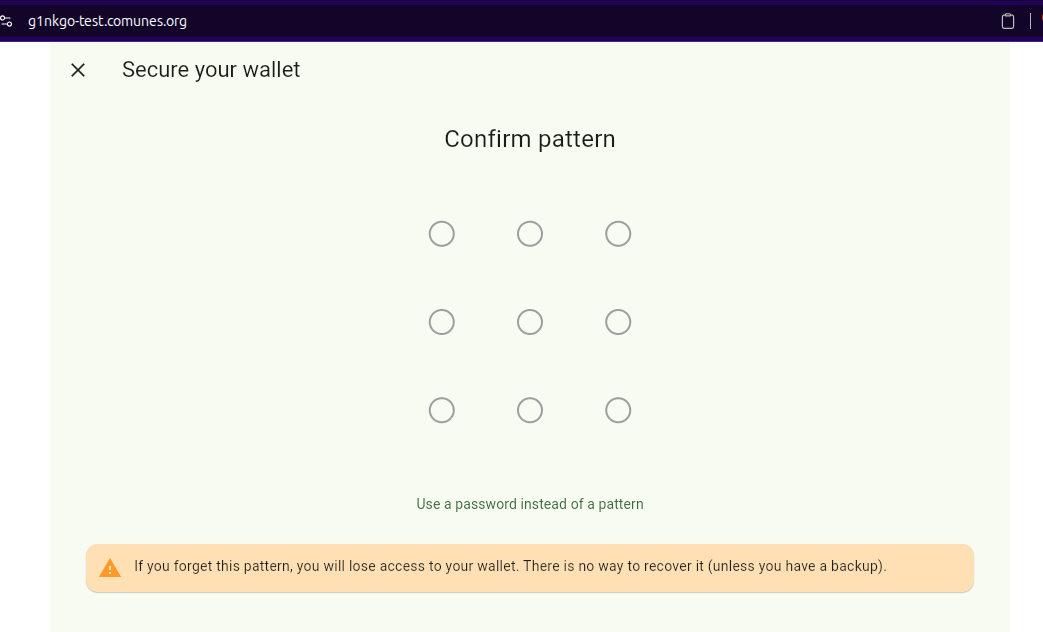
Sur https://g1nkgo-test.comunes.org/, je n’arrive pas à récupérer un compte à partir de la phrase de restauration, il me demande de dessiner mon motif.


Is G1nkgo ready for GTest #2?

Is it pointing to the right indexers and nodes?

On https://g1nkgo-test.comunes.org/, I can’t recover an account from the recovery phrase; it asks me to draw my pattern.

[EN]
Hi @Maaltir, I was working this weekend on it.

Although is not 100% proud of the result, you can try it in, for instance:

there is a linux version too:

and yes

It was too late and I couldn’t write a post.

About the draw pattern, it’s an extra security layer that you added in some point (like the biometric part in android). It’s independent of the seed/mnemonic.

And yes, it should be pointing to the right addresses and nodes.

FR:
Salut @Maaltir, j’ai travaillé dessus ce week-end.

Même si je ne suis pas entièrement satisfait du résultat, tu peux l’essayer, par exemple :

Il existe également une version Linux :

et oui:

Il était trop tard et je n’ai pas pu écrire de message.

En ce qui concerne le motif de dessin, il s’agit d’une couche de sécurité supplémentaire que vous avez ajoutée à un moment donné (comme la partie biométrique dans Android). Elle est indépendante de la graine/mnémonique.

Et oui, elle devrait pointer vers les bonnes adresses et les bons nœuds.

Traduit avec DeepL.com (version gratuite)

2 Likes

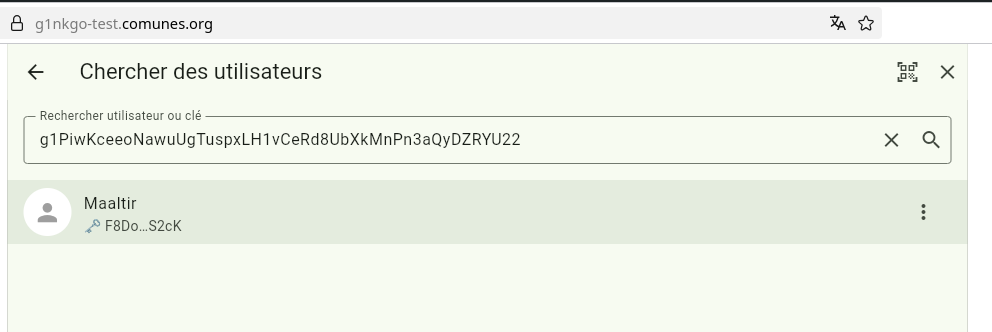
J’ai migré mon compte membre avec Gecko vers le compte : g1PiwKceeoNawuUgTuspxLH1vCeRd8UbXkMnPn3aQyDZRYU22

Quand je le cherche dans G1nkgo il me trouve mon ancienne clé,

I migrated my member account with Gecko to the account: g1PiwKceeoNawuUgTuspxLH1vCeRd8UbXkMnPn3aQyDZRYU22

When I search for it in G1nkgo, it finds my old key,

Cela me perturbe, car mon compte membre n’est plus sur cette ancienne clé.

This bothers me because my member account is no longer on that old key.

Oui, mais quand j’importe un compte à partir d’une phrase de restauration, je n’ai pas de motif à dessiner, alors je me dis que je dois le choisir, mais j’ai une erreur “mauvais motif”, donc ce n’est pas ça.

Yes, but when I import an account from a restore phrase, I don’t have a pattern to draw, so I think I have to choose one, but I get an ‘incorrect pattern’ error, so that’s not it.

[FR]
Que s’est-il passé selon moi ?

Je pense que nous utilisons ces applications et ces portefeuilles à titre d’essai, à différents moments, puis nous oublions ce que nous avons fait, car il s’agit d’essais et nous ne les utilisons pas réellement. Nous oublions donc certaines choses, nous ne les notons pas ou ne les mémorisons pas correctement, etc.

G1nkgo crypte votre contenu sensible (portefeuilles et sauvegardes/exportations) à l’aide de motifs. Ce sont des motifs choisis par les utilisateurs, qu’ils doivent ensuite répéter pour pouvoir accéder à leurs portefeuilles ou sauvegardes. Ce n’est pas quelque chose généré par g1nkgo. C’est quelque chose choisi par l’utilisateur, tout comme dans Gecko et Cesium2 (je crois) où vous choisissez un mot de passe pour faire exactement la même chose, protéger les informations sensibles (votre portefeuille). J’ai aimé choisir un autre mécanisme pour ne pas embrouiller les gens avec plus de mots de passe (les classiques de cesium v1) et c’est pourquoi j’ai choisi les modèles.

Peu importe que votre portefeuille soit de type seed ou classique cesium avec mot de passe/password, il est protégé de cette manière par une couche de sécurité supplémentaire, et si quelqu’un s’empare de votre téléphone portable ou de votre navigateur, il ne peut pas accéder à vos portefeuilles.

Dans g1nkgo, au lieu d’utiliser un motif, vous pouvez également utiliser la biométrie, je pense que c’est similaire dans Gecko. Autrement dit, au lieu d’un motif, sur Android, vous pouvez utiliser la biométrie.

Pour en revenir à votre cas, que s’est-il passé ? Je pense qu’il y a quelques mois, vous avez essayé G1nkgo, vous avez saisi un motif pour sécuriser votre portefeuille et maintenant, quand il vous le redemande, vous ne vous en souvenez plus, car c’est quelque chose que vous avez défini à titre d’essai, sans que ce soit une utilisation réelle, et vous avez saisi

Traduit avec DeepL.com (version gratuite)

[ES Orig] ¿Qué creo que sucedió?

Lo que pienso es que estamos usando estas apps y estos monederos para probar, en diferentes momentos y luego no recordamos que hemos hecho, porque son pruebas y no estamos usándolos de verdad. Entonces, olvidamos cosas, no las apuntamos o memorizamos convenientemente, etc.

G1nkgo encripta su contenido sensible (monederos y backups/export) con patrones. Son patrones que eligen los usuarios y que luego, deben repetir para poder acceder a sus monederos o backups. No es algo generado por g1nkgo. Es algo elegido por el usuario, al igual que en Gecko y en Cesium2 (creo) eliges una contraseña para hacer exactamente lo mismo, proteger la info sensible (tu monedero). A mi me gustó elegir otro mecanismo para no confundir a la gente con más contraseñas (las clásicas de cesium v1) y por eso elegí lo patrones.

Da igual que tu monedero sea de semilla o un clásico de cesium de passprase/password, queda protegido de estas forma con una capa adicional de seguridad, y si alguien se hace con tu móvil o navegador, no puede acceder a tus monederos.

En g1nkgo en vez de usar un patrón también puedes usar biometría, creo que en Gecko es parecido. Es decir, en vez de patrón, en Android, puedes usar biometría.

Volviendo a tu caso, ¿qué pasó? pues creo que hace unos meses probaste G1nkgo, metiste un patrón para asegurar tu monedero y ahora cuando te lo vuelve a pedir, no lo recuerdas, pq es algo que estableciste en un momento a modo de prueba, sin que fuera un uso real y metiste cualquier cosa.

¿Qué puedo hacer yo al respecto? Ahora mismo, con esta versión nada más que pedirte que hagas memoria. En otras versiones, puedo hacer una opción para resetear tu patrón, con lo que perderías tus monederos encriptados con ese patron, pero a cambio, podrías volver a importar de nuevo la semilla de tu monedero, y hacer mejor memoria al establecer un nuevo patrón para guadarla (o usar biometría).

Espero haber sido claro.

PD: Este tipo de problemas y confusiones que estamos teniendo entre el grupo de testers me hacen convencerme más y más que deberíamos migrar a v2 con las cuentas clásicas de v1, migrar la red y luego en otra fase, pasar a usar cuentas con semillas paulatinamente, etc. Si no, vamos a tener que explicar muchas veces a los usuarios cosas como esta y va a ser muuuy cansado. Pero es mi opinión, una vez más, perdonad que insista.
Mon problème est celui d’un compte crée avec Gecko, avec une phrase de restauration de 12 mots. Cette phrase se suffit à elle-même pour restaurer un compte, même plusieurs comptes.
Dans Gecko, j’ai associé un code PIN, pour l’usage au quotidien.

J’ai pu restaurer ce compte dans Ǧ1-companion avec uniquement la phase de restauration. Ǧ1-companion m’a aussi demandé d’associé un code secret pour l’usage au quotidien.

Quand j’essaie de restaurer ce compte dans G1nkgo, la demande de motif à dessiner me bloque, car à l’origine, il n’y a pas de motif. Il y aurait un motif si j’avais exporté ce compte avec G1nkgo, mais ce n’est pas le cas.
Donc soit G1nkgo ne prévoit pas la restauration de compte créé sur une autre application, soit il y a un bug.

[EN]
My problem concerns an account created with Gecko, with a 12-word recovery phrase. This phrase is sufficient on its own to restore an account, or even multiple accounts.

In Gecko, I associated a PIN code for everyday use.

I was able to restore this account in Ǧ1-companion using only the recovery phrase. Ǧ1-companion also asked me to associate a secret code for everyday use.

When I try to restore this account in G1nkgo, the request to draw a pattern blocks me, because there is no pattern to begin with. There would be a pattern if I had exported this account with G1nkgo, but that is not the case.

So either G1nkgo does not provide for the restoration of accounts created on another application, or there is a bug.

Translated with DeepL.com (free version)

[ES]
Mi problema es el de una cuenta creada con Gecko, con una frase de recuperación de 12 palabras. Esta frase es suficiente para restaurar una cuenta, incluso varias cuentas.

En Gecko, he asociado un código PIN para el uso diario.

He podido restaurar esta cuenta en Ǧ1-companion solo con la frase de recuperación. Ǧ1-companion también me ha pedido que asocie un código secreto para el uso diario.

Cuando intento restaurar esta cuenta en G1nkgo, la solicitud de dibujar un patrón me bloquea, ya que originalmente no hay ningún patrón. Habría un patrón si hubiera exportado esta cuenta con G1nkgo, pero no es el caso.

Por lo tanto, o bien G1nkgo no prevé la restauración de cuentas creadas en otra aplicación, o bien hay un error.

Traducción realizada con la versión gratuita del traductor DeepL.com

[FR] Ok, je vois maintenant. Et oui, c’est un nouveau bug (j’ai dû faire un test dans un tout nouvel environnement, dans une fenêtre de navigation privée, pour le voir). Ça fonctionnait sans problème pour moi, car j’avais déjà défini mon propre modèle. Je vais régler ça dès que possible. Désolé pour le désagrément.

[ES] Ok, ahora lo veo. Y sí es un bug nuevo (he tenido que probar en un entorno totalmente nuevo, en una ventana de incognito web para verlo). A mi me funcionaba sin problema, pq ya tenía establecido mi patrón propio. Lo soluciono ASAP. Perdona por las molestias.

3 Likes

[EN] Fixed. Works for me in g1nkgo-test:
[FR] Corrigé. Ça fonctionne pour moi dans g1nkgo-test:

1 Like

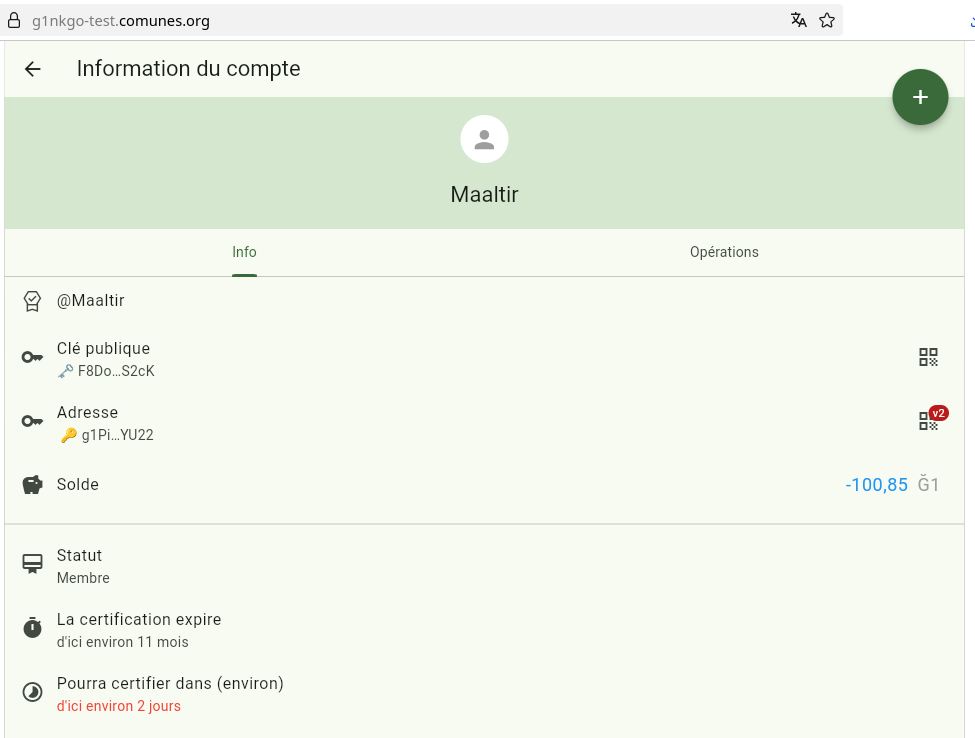
J’ai utilisé ma phrase de restauration pour accéder au compte vers lequel j’avais migré mon identité membre,

Mais quand je vais voir sur l’ancienne adresse, (celle avant migration)
Je vois un solde négatif, normalement, c’est impossible ! Erreur d’indexer ??
Je vois un statut membre alors que ce compte n’a plus ce statut depuis que je l’ai migré.
Ce n’est pas la certification qui expire, mais l’adhésion, le statut de membre de la TdC

I used my recovery phrase to access the account to which I had migrated my member identity,

but when I check the old address (the one before migration),
I see a negative balance, which is impossible! Indexing error?
I see a member status even though this account no longer has that status since I migrated it.
It is not the certification that expires, but the membership, the WoT membership status.

Pour cette partie de solde oui c’est un bug squid, gecko n’a pas le bug car il n’utilise pas l’indexer pour les soldes, il fait le compute lui même.

Il faut corriger côté Squid: Add balances to squid accounts - #32 by vjrj

2 Likes

Why is now returning a hash!

{
"hash": "0x320a5aac8c0e6d7cbcbbedfc6b9fe1d6d03fa07951306392e1c674c9f4b5fa08"
}

This is causing the G1nkgo wallets just updated to start using v2 :frowning: .

Because i’m testing the flow.
The hash has been removed since.

1 Like

What a bad idea!

So many bad ideas:

  • Using the same app running on both v1 and v2 networks, which is so confusing for testers, a problem that has been pointed out many times
  • Not coordinating with the rest of the team on implementation choices, both for export and import data formats, forced to chase after export formats in the rest of the ecosystem, which makes it possible to remain interoperable.
  • Not contributing to the common lib durt2, redoing everything yourself
  • Offering no significant protection when using member accounts in your app, ignoring recommendations for years
  • Proposing an app name that is extremely similar to an existing app that does almost the same thing, great for not losing people

Now please use your own endpoint for g1 genesis hash.

1 Like

I didn’t want to respond again but what you say is innacuerate, sometimes false and… no also not fair.

So many bad ideas?

  • Wrong you have a network chooser too and a auto-switch… testers? I’m thinking in normal users… A detail. I developed G1nkgo because Cesium was not working at that time, you were developing v2, etc. Cesium started to be maintained again (thanks to kimamilla that returned), and we continued working these years in v1, collaborating with all the difficulties of the current network. G1nkgo is in use by people since the first version. It’s a “little” difficulty we have in this migration that people is using it right now, in the web, in the app etc.
  • I coordinate with many of you. G1nkgo export/import to compatible Cesium formats. Gecko can import/export ewif/wif? It’s a question, I’m not sure which export in Gecko are you talking about.
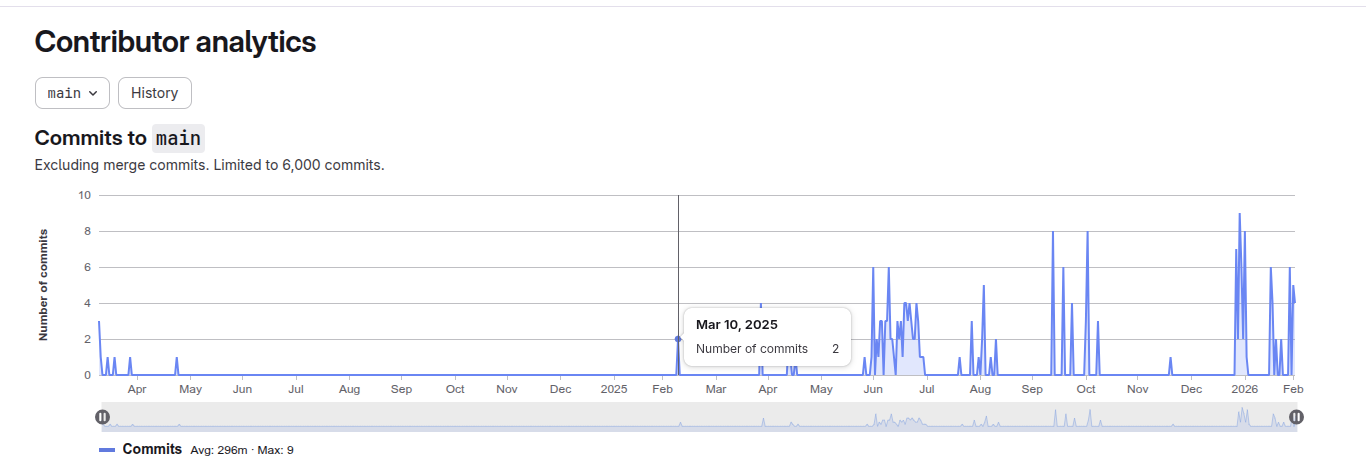
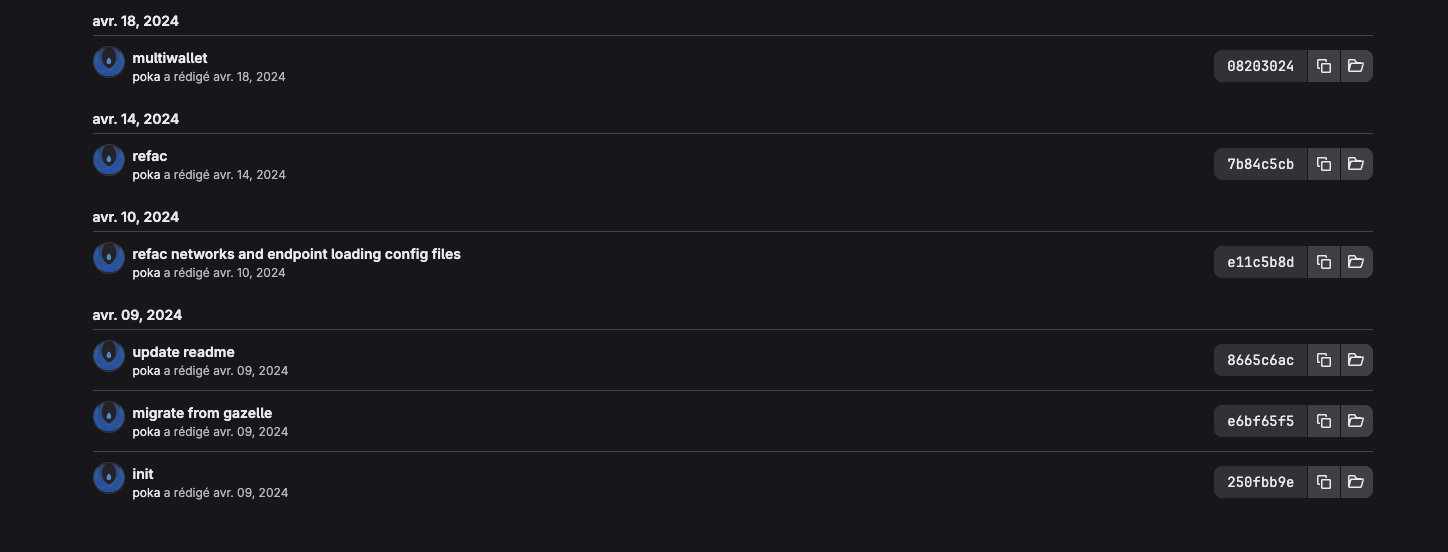
  • You offered to use durt2 some weeks ago. Quite late. When I started with g1nkgo v2, durt2 was nowhere. When I added wot to g1nkgo the past year, durt2 was nowhere. I decided to use polkdart and give web support there when gecko was using the js lib that I didn’t like. Later you switched to polkadart too. This is durt2 for the record:

    at that time I was testing v2 and fixing things. As I mentioned in a meeting I tried to export my generated v2 code in a common lib, but didn’t work with the generation lib I’m using (ferry). So that libs are in g1kngo/packages all together. But at least I contributed with polkadart and I have to continue doing (web is broken again in recent versions BTW).
  • G1nkgo started because the Spanish community asked for a instant duniter web wallet for non-member accounts (even I was not a member), but later people started to ask for this and that, for an app, for member accounts support, for v2, … Anyway for my understanding g1nkgo offer the same protection for members accounts than others. Even in v1, all the member authentication is only in memory, and now in a secure storage.
  • Sorry for using the Ğ!. Also, if you didn’t noticed, gcli, sounds also a bit like gecko…

I also read things from you for the first time that you say have been said continuously…really?

Instead of simple “oops, sorry” for pressing the migration button (that others contributors suggested me to use), you/we are wasting our time with reprochs.

Anyway, v2 is almost there, and I only thinking in celebrating it and take a rest. So please calm down.

PS: And about more collaboration, I have some extra ideas for the future… but not for now that we have enough food in the plate.

1 Like

This is v1 export format, It has no place in v2.

I don’t understand what you’re talking about; your screenshot doesn’t show anything.

durt2 firsts commits:

Have members made a note of their mnemonic when using the app?
Are they guaranteed that if they lose their phone, they won’t lose access to their account?

Aha, it’s not about the G, but the entire pronunciation of the name. Don’t be silly with me.

There’s no problem with that, the flow needs to be tested. I’m not going to go into production without doing any standard flow tests!

Sorry for focusing on migration and not being able to support all apps at the same time. I’m doing my best to ensure that the migration goes as smoothly as possible.

Well, I can’t wait to see that.

2 Likes

Why not? I decided to go with wif/ewif for Silkaj v0.20.

It doesn’t seem incompatible with mnemonics. Does it?

Because there’s no reason for it to be! Polkadot already offers a format suitable for export/import that is compatible with the entire ecosystem.

But above all, we had agreed to only offer imports/exports via mnemonic, and no other way, because otherwise it adds no value for the user, except to add more and more useless formats!

This is not final or definitive, but simply the current state of our thinking. In the absence of an RFC for v2 on this subject, any other format is unofficial. And if you propose your own format, the apps will no longer be compatible with each other.

It’s becoming quite unbearable to chase after the implementations of each app.

I added the import of these legacy formats in Cesium2 to ensure continuity during the migration, nothing more!

I made it clear that I deliberately did not implement the export; it’s not a matter of forgetfulness or laziness!

I had already had to manage the g1nkgo export format in Duniter Connect, as a reminder:

This syntax

june://4pJjXCrbFvHu1RvYBgymTJg1GRjMBmM91MyEALPxQiHL:5v7?amount=2.0

found in Ginkgo to receive Ğ1, in payment terminal mode, could become a standard among clients.

Because of it’s very thoughtful and practical.

And so not to use the Cesium one format for g1link ??

Are you all aware that we have RFCs to standardize our protocols?

Welcome to the jungle!

I’m ending this discussion here because it’s going off in all directions and I have enough work as it is.

1 Like